A Fresh Start on Gran Canaria

Translated by AI
The Canary Islands are once again a favorite winter destination for northern Europeans, after a few years in the shadow of the Thailand phenomenon. Part of the explanation for the comeback may be the perfect climate, the relative closeness to the rest of Europe and the security of traveling within the EU, with all the advantages that brings. But a good deal is probably also down to new investment in quality, in the same way that Mallorca was transformed from a slightly shabby vacation spot into a luxury destination.
We went to Gran Canaria to see how that has affected the golf.
When it comes to golf, Gran Canaria has long been somewhat in the shadow of Tenerife. Tenerife has marketed itself as the number one golf island, with great success. But how has golf on Gran Canaria developed?
“Bandama was founded in 1891, which makes it the oldest golf club in all of Spain”
For a long time there was only one course on Gran Canaria, the classic Real Club de Golf de Las Palmas, usually just called “Bandama.” The club was founded in 1891, which makes it the oldest golf club in all of Spain. The course was originally in the capital, Las Palmas, but in the early 1950s it moved to its current site next to the Caldera de Bandama crater, a little south of the city.
Toward the end of the 1960s, tourism to the Canary Islands grew rapidly, and Las Palmas and the classic Las Canteras beach were no longer enough. Tourism moved south, and the resort areas of San Agustín and Playa del Inglés grew up. Just south of Playa del Inglés lies the Maspalomas nature reserve, with four square kilometers (about 1.5 square miles) of sand dunes, and right next to this desert a new course was built in 1968, Maspalomas Golf.
After that, not much happened on the golf front for more than 30 years. But around the turn of the millennium things started to move. New areas were developed for tourism, and new courses were built. Those were the courses we were here to test.
Anfi Tauro Golf
First up for us was Anfi Tauro Golf. The course lies in the Tauro valley, just west of Puerto Rico, at the end of the GC-1 highway. It was completed in 2003 and is part of a larger tourist complex that stretches from the beach far up into the valley. There is everything from apartments to private villas, to buy or rent. If you own an apartment or villa in the area, you can join the club at a very affordable price.
The course starts with a few fairly easy holes, but it quickly gets narrower and harder. On the 6th, a short par 3, you are greeted by a wonderful view of the green with the sea in the background. The 7th offers a difficult approach with water all along the right side up to the green. The 8th is perhaps the signature hole, with the green carved straight out of the rocks.
On the back nine the course climbs up into the ravine. When it turns on the 13th, you get a wonderful view of the whole course and the sea below, and on the 14th it drops steeply. This is where you can hit the longest drive of the day, no question!
The fairways on the back nine are largely bordered by ravines on one or both sides, so you have to hit it straight. That is exactly why the course may not be one to recommend for high handicappers; it can be a long and rather frustrating day. The day we played we passed no fewer than five four-balls, every one with one or more players searching for balls in the ravines. This despite ideal conditions, with a temperature typical of the Canaries of 24°C (75°F), sunshine and no wind.
When we asked at reception whether we really needed to rent a golf cart, we were first met with puzzled looks and then with laughter. Of course you need a cart! And having played the course, we are inclined to agree. It is very steep, and it’s often a long way between holes.
Anfi Tauro also has a short course with only par-3 holes. Next to the short course is the driving range, which for some obscure traffic reason you are not allowed to drive to in your golf cart.
Meloneras Golf
Meloneras Golf is the new course closest to the resort areas of Maspalomas, Playa del Inglés and San Agustín. It lies just west of the somewhat more upscale resort town of Costa Meloneras, which has grown up around the lighthouse at the southern tip of Gran Canaria. A short taxi ride from most hotels in the area. Meloneras Golf is also the newest of the courses, opened as recently as 2006.
The feeling you get playing Meloneras Golf is that the front and back nines are two different courses. The front nine is played in a palm-lined “bowl.” The holes go back and forth between the palms, and not much happens. A little water and a few ditches here and there, but the holes are mostly straight and the fairways wide. Not bad, but not memorable either. By the time you get back to the clubhouse, there’s no hole you particularly remember.
The back nine is completely different. Now the course winds along the Atlantic coast, with fine views and steep cliffs beside the fairway on most holes. Much more exciting, though without a real “signature hole.” But plenty of holes well worth playing.
The course suits golfers of every level, although some of the tee shots require a certain length to get the ball in play. Golf carts are available, but the course is also perfectly walkable. The sea breeze means it never gets oppressively hot.
The clubhouse has a well-stocked pro shop and both a cafeteria and a somewhat finer restaurant, excellent for lunch after the morning round.
Salobre Golf
Just after passing Costa Meloneras on the GC-1 highway, we turn off to the right onto a small road that winds steeply up into the coastal hills. Are we on the right road?
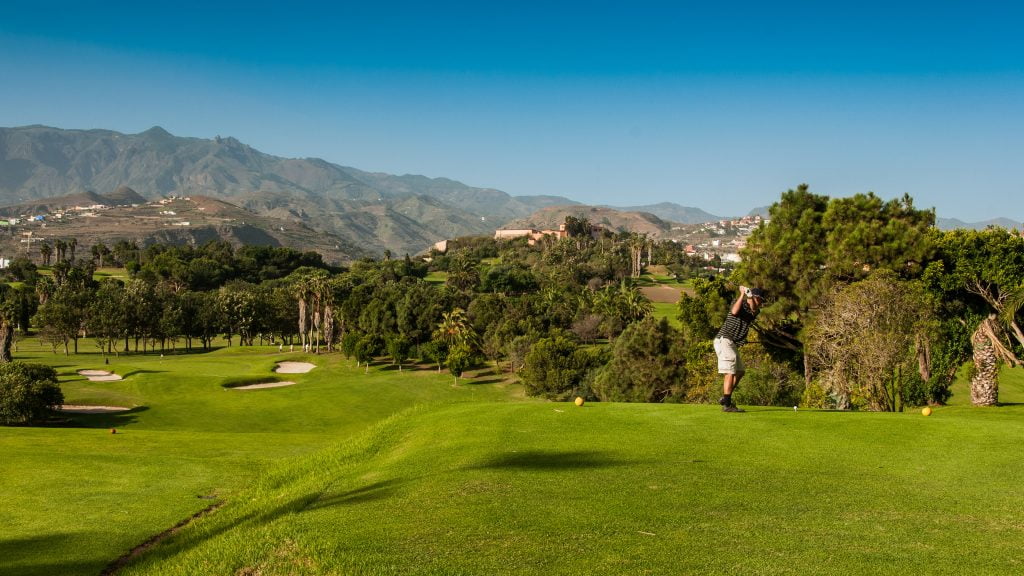
Salobre Golf sits up in the hills, with a fantastic view of the sea and Maspalomas. There are two courses, South and North, plus a Sheraton hotel. There are also a number of villas for rent.
The South course was built first and was ready for play in 2000, while the North course is brand new. The South is the better course, so we chose to play it.
Like Anfi Tauro Golf, the course climbs up into ravines, but not quite as dramatically. It starts gently, with a wide, fine first fairway, but it gets trickier and trickier as you go. As on most courses in the Canaries, there isn’t much grass in the rough; it’s mostly sand and cactus. So here, too, it’s important to stay “on the green stuff.”
After four holes you reach the highest point of the course, with a beautiful view of the whole resort. The course lies as if in a bowl between the hills, with the clubhouse at one end and the 4th green at the other. From the 5th it heads back down toward the clubhouse, and from the 10th it sets off again on a similar tour of the hills. The back nine is a bit of a repeat, though with a beautiful oasis at the 15th green and 16th tee.
The quality of the course and of the resort as a whole is high, perhaps the best of the courses on Gran Canaria. If you are here just to play golf, an excellent option is to stay at the Sheraton next to Salobre Golf. You get two fine courses to play, a view of the courses from your hotel room, and you can drive your golf cart straight from the hotel onto the course. If you want to go to the beach, there’s a free shuttle; it takes about 20 minutes.
Bandama
After trying the new courses, we headed for the place where it all began: Real Club de Golf de Las Palmas, or Bandama, as it’s popularly called.
Bandama is closer to Las Palmas than to the south coast, but it’s under an hour by car. Make sure you have a GPS or a good map; it’s easy to get lost in the many mountain villages. But the road there is part of the experience, with picturesque towns and beautiful views.
The course lies on a plateau right next to the Caldera de Bandama, a crater formed when the ground collapsed after a volcanic eruption. The crater itself is 1,000 meters (3,280 feet) across and 200 meters (650 feet) deep, and the rim where the course lies is about 500 meters (1,640 feet) above sea level. All of which makes for exciting golf and spectacular views.
Not many tourists come here; Bandama is first and foremost a members’ course. For non-members it is only open on weekday mornings. That makes the atmosphere much more relaxed than on the southern courses. Here it’s not about getting as many golfers out per hour as possible; the golf comes first.
The course isn’t particularly long, nor too difficult. The design is a little more traditional; it’s a course built in the 1950s. But that doesn’t make it dull in any way. Bandama offers interesting challenges, not least by demanding a certain precision to avoid ending up among the cactuses or, even worse, down in the crater. Well worth a visit.
Don’t forget to visit the clubhouse, restaurant and bar after your round. The clubhouse has traditional décor, a mix of British and Spanish style. And the restaurant has a magnificent view of the whole course. Also take a look at the board of club champions: in recent years most of them have had the surname Cabrera-Bello.
Before you head home, we recommend a visit to Pico de Bandama, the highest point of the volcano. From here you can see the whole course and the volcanic craters, and looking north you have a fine view of Las Palmas.
Maspalomas Golf
Last up this time was Maspalomas Golf, the first course built on the south coast, opened in 1968.
Maspalomas Golf’s main attraction is its central location, next to the Maspalomas Dunes, Playa del Inglés and Costa Meloneras. A couple of minutes by taxi from most hotels in the area.
Otherwise the course is rather dull for the experienced golfer. Mostly straight, flat and wide fairways make it easy to play. Even if you hit it short and crooked, you’ll always find your ball. But perhaps that’s the point. Anyone can play Maspalomas, and play moves along at a decent pace, even with the course full of four-balls of German tourists.
The clubhouse is well equipped, the pro shop has a good range, and the restaurant is airy and pleasant, with food at reasonable prices. We recommend the course for high handicappers and beginners. Here you can play without getting too frustrated by that annoying little white ball.
Other courses
There are two more golf courses on Gran Canaria, El Cortijo Club de Campo and Oasis Golf, both on the north side, not far from Las Palmas. El Cortijo Club de Campo is an 18-hole championship course that hosted, among other events, the 2002 Spanish Open. Oasis Golf is an 18-hole par-3 course (par 54) whose main attraction is that it’s floodlit and open for late evening rounds.
Where to stay
We definitely recommend staying somewhere along the south coast if you plan to play golf. The south coast stretches roughly from San Agustín to Puerto Rico and Mogán. The resorts each have a slightly different character, which can be summed up like this:
• San Agustín: the oldest resort on the south coast is now one of the quietest and caters mainly to an older clientele.
• Playa del Inglés: party, party, party. Playa del Inglés caters to young people and families. There’s a bit of everything for everyone, but it feels a little cheap, a little too touristy.
• Costa Meloneras: once you pass the lighthouse, you come to Costa Meloneras. Here you’ll find many of the more upscale hotels, some of them aimed especially at golfers. A good choice if you plan to play Meloneras Golf or perhaps Salobre Golf.
• Puerto Rico: good if you want to rent an apartment, but there are also good hotels. Puerto Rico has a fine, if crowded, sandy beach with every beach activity imaginable, from parasailing to banana boats. Many fishing trips and whale-watching tours also leave from here. Close to Anfi Tauro Golf.
• Mogán: even farther along the southwest coast lies the small fishing village of Mogán. Still fairly authentic. A calm atmosphere and somewhat more upscale accommodation. A bit out of the way for golfers, but close enough if you have a car.
Conclusions
Golf on Gran Canaria has made great strides in the last ten years. If you haven’t been here since the 90s, there are several fine courses to discover. Above all, don’t miss Anfi Tauro Golf and Salobre Golf, and if you have the time and opportunity, try to fit in Bandama. If you are staying along Costa Meloneras, Meloneras Golf is close by and convenient, and several of the hotels have free shuttle buses. For high handicappers, Maspalomas Golf is the one to choose.
The climate on Gran Canaria is perfect for golf, around 24°C (75°F) all year, often with a cooling sea breeze. The south coast has the best climate, with the most hours of sunshine. A year-round destination for golfers.
This article by Bo Sjosten was originally published in Swedish on our sister site Golfjournalen.se. It has been translated by AI.