Heavenly calm: few golfers in Poland

Translated by AI
First hole, second hole … fifth … twelfth … and now the 18th! Where is everybody? Not a four-ball, not a two-ball, not even a single golfer either ahead of us or behind us.
Postolowo’s championship course lies open, still and silent as I take out the driver, take my stance and send the ball out over a dew-glistening fairway.
A sacred morning calm rests over the course. There’s no stress here, no lines. This is golf Polish style: top class and relaxing.
Postolowo
Poland is certainly a big country with 40 million inhabitants. Maybe there are lines at the golf courses in other parts of the country, but I’m talking about the northeast, the Tri-City area of Gdańsk, Gdynia and Sopot. Within a radius of 30 to 40 kilometers (20 to 25 miles) there are two first-class courses here and a third on the way.
I arrived here one morning on the ferry from Karlskrona in Sweden. Gdansk Golf & Country Club, or Postolowo GC as it is also called, with its championship course was an obvious visit.
Not a single “fore,” not a single rattle of clubs being lugged around on someone’s back.
Not a single “fore,” not a single rattle of clubs being lugged around on someone’s back. Just endlessly beautiful and dramatic views, the rustle of birch and oak, immaculately groomed courses and undisturbed concentration on every shot, every putt. A feeling of total focus that shuts out everyday worries and thoughts of quarrels and other misery. That must be how our friends from the past felt, too.
Perhaps the pleasant feeling at Postolowo can also be explained by how much at home a Scandinavian golfer feels here. The nature is much like the Scandinavian countryside, and the course was designed by Jeremy Turner, who has designed lots of courses in Sweden. What’s more, the whole facility came about thanks to a Swede, Matti Idman. Together with good friends, he got the project started in the early 1990s. Five years later William Siwek, an exiled Pole and shipbroker, joined the project. That got the finances moving, and in 1997 the 18 holes were opened.
Dramatic golf holes
Postolowo is set in very beautiful countryside. When Jeremy Turner had finished the project he said that “this will be a course I am proud to be associated with. It is quite spectacular, with the magnificent lake inviting breathtaking possibilities for dramatic golf holes.”
Turner was of course an interested party, but an experienced independent expert like Jeffrey P Collinge, a Dutch specialist in golf course construction and maintenance, also thinks Postolowo is unusually beautifully located in exciting terrain. It could become one of Europe’s 50 best courses.
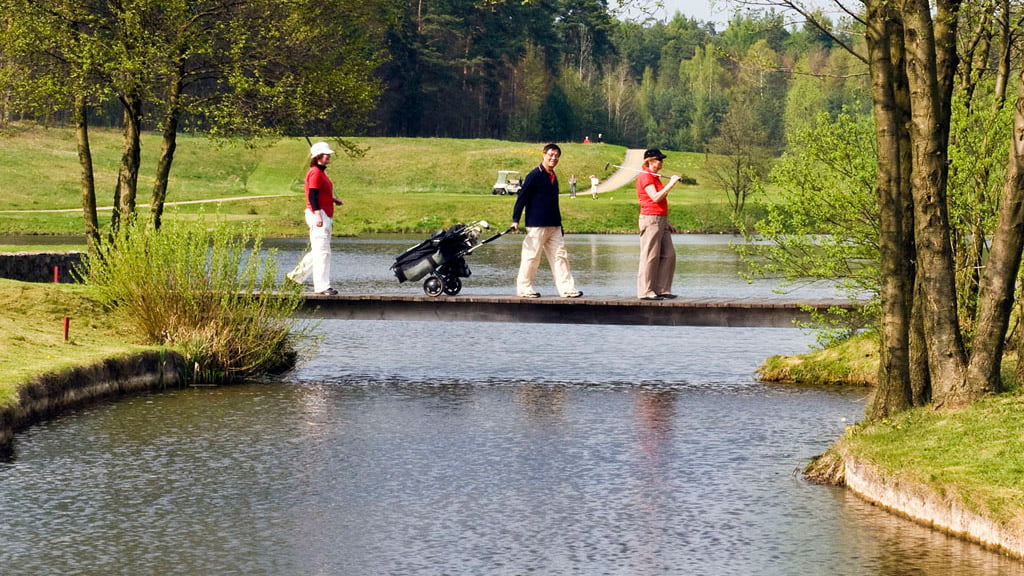
The Polish Open was played here as early as the course’s first year. Several national and international championships have been held since then. So it’s with some excitement and curiosity that I head out on the course. Already on the fourth hole I’m met by a fairly tough par 5 that runs nervously close to a lake shore and finishes with a shot right across the lake to the flag. Water is a rather interesting ingredient at Postolowo in general. The 16th is a short hole over water (186 meters, or 203 yards, from the yellow tee) with an eerily psychological little slope from the water up to the green. Get the ball up on the green or back down into the water is pretty much how it goes.
The 17th gives no respite from the water either. It’s a short, tricky par 4 with the green idyllically, and treacherously, placed next to the water. Finally comes the 18th, a par 5 with water hazards everywhere. The first, second and third shots can all turn into a wet nightmare when, after a full round, your blood sugar has sunk into your shoes and your water bottle is empty.
As in other countries around the southern Baltic, golf has literally exploded in Poland. It has gone from zero to a hundred in about ten years. Even five years ago it was mostly Swedish and German golfers who found their way across the country’s borders and saw this virgin land ready to be conquered.
Today the Poles have accepted golf, perhaps not as a popular sport, but at least as a sport no longer reserved for the upper class. Slowly the Poles are finding their way to the courses, and the Polish Golf Union is gaining more and more members.
Even so, there’s a stillness on the courses that I’ve never experienced before. You might of course ask why the owners go to the expense of keeping their courses in top condition. The explanation is “the future.” Europe is changing fast, but the US is also getting closer and closer. And in the US there is enormous potential for the Polish golf market. Poles in exile like to visit their old homeland and, why not, bring their golf clubs.
But for now, eyes are turned first and foremost toward Scandinavia, not least toward the golf-crazy Swedes. Ferries and flights to the Tri-City area are getting more frequent, and ticket prices are falling fast.
About a million people live in the Tri-City area. The largest city is Gdańsk with its 450,000 inhabitants, capital of the Pomeranian Voivodeship. This is where the beginning of the end of Soviet rule started. The shipyard worker Lech Wałęsa led the uprising that eventually gave Poland democracy, and he also became the Polish republic’s first president.
Today the old Hanseatic city is buzzing with activity. The port is thriving, culture is very prominent, and the Old Town, which was almost completely destroyed in World War II, has been rebuilt.
It’s often said of the Tri-City area that in Gdańsk you walk in the footsteps of history, in Gdynia you shop, and in Sopot you relax.
The shops along Gdynia’s big pedestrian street Świętojańska and the stalls in Hala Targowa (the market halls) are well stocked. Most well-known clothing brands are here and are considerably cheaper than in Scandinavia. The same goes for almost everything from china, jewelry and garden tools to glasses and eye exams.
This article by Bo Sjosten was originally published in Swedish on our sister site Golfjournalen.se. It has been translated by AI.