Sun, Wind and Water – Links Golf in Ireland

Translated by AI
Ireland is a classic golf destination. We went there for a week in October to try some Irish fall golf. Would it be sun, wind or water?
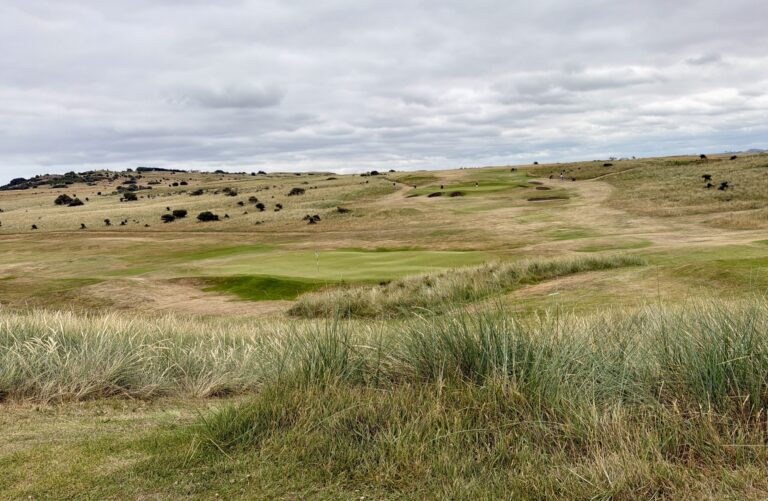
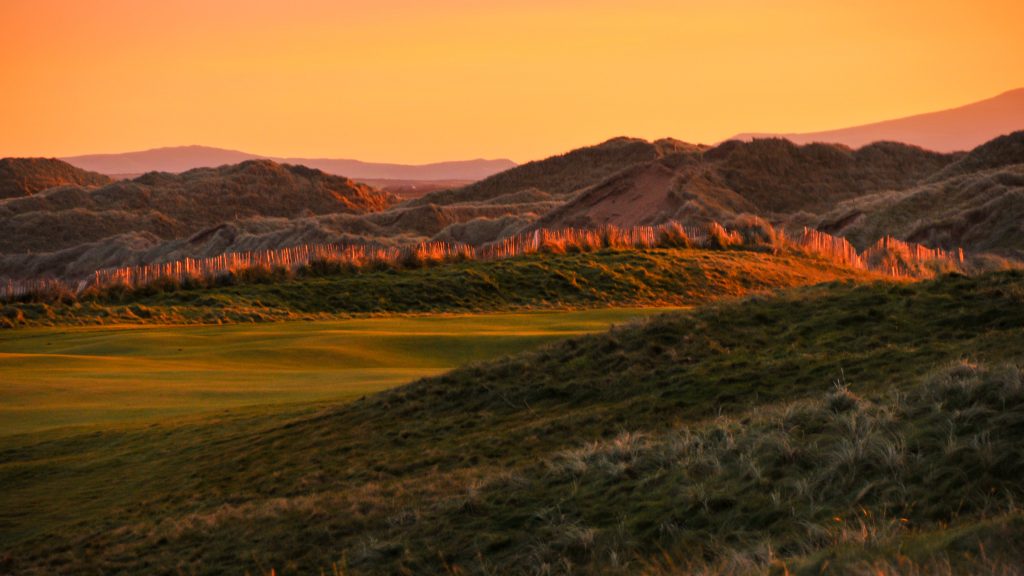
Ireland’s golf courses are shaped less by people than by nature. That is especially true of the links courses, the ones that wind through the sand dunes along the sea. One example is Doonbeg, the newest of all the links courses, designed by Greg Norman. On fourteen of the holes, the only thing they did was mow the grass on the fairways and greens. No design was needed; they simply followed nature. That is why some consider links golf the purest form of the game, played the way golf was played from the very start.
At the golf clubs you won’t find parking lots full of golf carts or paved paths along the holes. Here you walk. Preferably with a local caddie, and preferably fast. Slow golf has no place in Ireland. Malt whiskey (with an -ey), on the other hand, does, and it goes hand in hand with links golf. At Doonbeg we found a coffee hut between the 7th and 8th holes, where you could get Irish coffee, with or without the coffee!
Golf is played year-round. The weather is a little warmer in summer, but it can also be quite rainy. Judging by recent years, Ireland has acquired a new monsoon season in July and August, at least if you believe Shane, our local driver and resident weather expert.
Financial crisis
Not so long ago, Ireland was a poor country. But after joining the EU and adopting the euro, things have gone very well. From 1995 to 2007 the economy grew by a full 7% a year, earning it the nickname “The Celtic Tiger.” Taxes were cut and the rest of the world invested heavily in Ireland. Ireland now has the second-highest income per person in the EU, and it has been voted the best place in the world to live, based on factors such as health care, family life, political stability, climate(!), equality and safety.
But the clouds are gathering. The largest part of the national product comes from construction, and the current financial crisis is causing major problems in that sector. On top of that, most ordinary Irish people’s wealth is tied up in property, one of the problems that led to the financial crisis.
Many new golf facilities were built during the boom years. In 1986 the Golfing Union of Ireland had 248 member clubs; today it has 408. Now people worry about what will happen after all this expansion. The financial crisis comes up often in conversation. The biggest worry is the main source of income: American tourists.
“From Boston it’s only a five-hour flight to Shannon,” says John Dooley, the pro at Doonbeg. “We have groups who come over and play for the weekend.” A Doonbeg brochure we read listed the runway length at nearby Shannon Airport as 10,499 feet. Good to know if your private jet needs to land.
That tourism will probably drop off after the crisis. Perhaps that will also bring lower prices for hotels and green fees, which would suit the rest of us just fine.
Not that expensive
Golf in Ireland has a somewhat unfair reputation for being expensive. There are certainly plenty of expensive courses, but there are even more at reasonable prices. Many of the expensive ones are so-called “trophy courses,” famous names you play mainly so you can brag about it afterward, not necessarily because they are the best courses.
Of course it’s fun to come home and talk about the famous course, but if the golf experience comes first, there are many other courses, some even better than the big names. A good compromise is to play one trophy course on the trip and fill up with lesser-known, often just as good, courses. And if you still want to brag, you can always say, “Ah, but have you played …?” A classic way to get the last word.
We flew via Dublin to Cork and spent a week in southwest Ireland, where we managed five courses. Three relatively new courses, one classic and one trophy course. We played both parkland and links courses, both expensive and cheap.
Blarney Golf Resort
First up was Blarney Golf Resort, just outside Cork. Blarney is a new course, completed as recently as 2006. It was designed by John Daly, so we were curious how far we would have to hit it to cope.
The front nine is the hardest, especially the 8th hole, a par 5 of no less than 601 yards, uphill all the way. But it’s not that difficult, said Conor. Just do what John Daly does: a drive and a 5-iron!
The 10th hole offered another challenge, and a choice. The hole, a par 4, is a dogleg right that bends a full 270 degrees. A wooded hill blocks the view of the green from the tee, but if you want to gamble it’s only 160 yards to the green, with a pond just in front of it. Once again we heard what John Daly had done.
“Where’s the flag?” he asks his caddie on the tee.
“15 yards from the front edge, 10 yards from the pond.”
“Are you sure?” “Yes.”
Daly puts the ball a foot from the hole. With an 8-iron.
The back nine isn’t as exciting, but it isn’t dull either. The course is in excellent condition, especially considering how young it is.
At Blarney we got our first taste of the special Irish sunshine the locals call “liquid sunshine.” But the October weather was mild, so we got by just fine.
Blarney is a resort. Besides the clubhouse there is a large hotel and a first-class restaurant. Blarney has green fee arrangements with several nearby clubs and makes an excellent base for exploring the region. The hotel rooms are very spacious, with every imaginable feature, including free wired internet.
Lee Valley Golf and Country Club
The next stop on our trip was Lee Valley, another club near Cork, about 20 minutes by car from the city or the airport. Lee Valley is a family-owned club and is counted among Ireland’s 100 best courses. The green fee is between 30 and 50 euros (about $35 to $60), depending on the season and day of the week, very affordable for a course of this class. Lee Valley has a number of houses for rent. They sleep six and cost between 600 and 1,000 euros (about $700 to $1,170) per week per house, also very affordable.
Lee Valley is a parkland course with plenty of trees. A good mix of holes, a few par 4s that long hitters can reach, and some quite tough par 3s. The back nine opens up a wonderful view over Lee Valley. The course is in good condition with fast greens, and it is surprisingly interesting to play.
Two of the holes have so-called ringforts right next to the fairway. Ringforts are ruins in the form of a ring of stones, believed to have been the walls of fortified settlements from early times. Many believe they had a religious significance, and they are protected monuments. Many Irish people associate them with druids and magic.
Dooks Golf Links
Dooks was our first links course on this trip. It is one of the five oldest links courses in Ireland, designed by the members themselves in the late 1800s. Dooks lies about 30 km (19 miles) from Killarney, on Dingle Bay. The course has been called “one of the best kept secrets in Irish golf,” and we are inclined to agree.
It is a classic links course, with a magnificent view of the sea and Dingle Bay from every hole. The course is interesting but not too hard to play for a links. Then again, that may have been because we played on a sunny fall day without wind. The green fee of 85 euros (about $100) feels like a good deal for a course this fine.
Doonbeg
Perhaps the very best of the new golf clubs, and even among the older ones, is Greg Norman’s masterpiece, Doonbeg Golf Links. Doonbeg opened cautiously in 2002 and was fully finished when the hotel, which is also the clubhouse, was completed in 2006.
Doonbeg Manor
The first thought that struck me when I walked into our suite was: I want to live here!
“I want to live here” was my first impression of the suite at Doonbeg. [Photo: Bo Sjosten]
Doonbeg Manor is built in traditional style. It’s easy to get the impression that it has always stood here, for hundreds of years. But it is brand new, finished as recently as May 2006. All rooms and cottages are suites with between two and four rooms. Our suite was in the main building and had a living room, kitchen, dining area, TV corner and three large double bedrooms, all with a private bathroom and shower. About 150 square meters (1,600 square feet) in all, very tastefully decorated in traditional style with Irish art. We felt at home the moment we walked through the door.
The golf course
This is what Greg Norman has said about golf: “I love links golf. The ball is round and made to roll. Landing it next to a flag 169 meters away and then putting back 15 centimeters isn’t for me. Carrying it to the front edge of the green, figuring there are 150 feet of green to roll on and wondering whether I can stop the ball, that’s a challenge.” Fittingly, Greg’s biggest successes have come on links courses, most recently at the 2008 British Open, where he led well into the final round.
The course stretches 2.5 km (1.5 miles) along the sea, with the 9th hole farthest from the clubhouse, as is usual on a links. The course follows nature: on 12 of the holes they only mowed the grass, and no other changes were needed. That makes the course feel very natural; it really feels as if you are playing the same kind of course golfers played 150 years ago. All that’s missing is a few hickory clubs and feather balls.
The course has a reputation for being difficult, but if you hit it reasonably straight and keep the ball in play, it’s not impossible to score. We even found most of our balls in the rough, where the coarse dune grass often left the ball in plain sight. The wind, of course, complicates things. The 14th hole, a 100-meter par 3 out toward the sea, is played with anything from a sand wedge to a 5-iron depending on the wind. The greens were in very good condition. One interesting touch was the green on the 12th hole, which had a bunker in the middle!
Doonbeg was without doubt the highlight of this trip. If you get the chance, you should definitely play here and stay a night on your golf trip to Ireland.
Dromoland
Our last course this time was Dromoland G&CC, just north of Shannon. Dromoland Castle dates back to the 11th century. In 1962 it was converted into a hotel, and in 1987 it was bought by Irish-American interests. In 2003 the surrounding golf course was redesigned and given its current layout.
The course rolls through the woods and meadows around the castle. It is exciting and in very good condition. We played on a very rainy day, but the sand-based greens were still playable. Especially beautiful are the 7th hole, a par 3 with the green far below the tee and surrounded by water, and the 18th, a par 5 that ends the round with a magnificent view of the castle. Well worth a visit, especially combined with a night at the hotel and dinner at the restaurant, perhaps the best restaurant in Ireland?
Sun, wind and water
So what was the weather like: sun, wind or water? We got all three. One day of brilliant sunshine, two with showers and two with wind. But even in October the climate is fairly mild, and despite the weather the golf was pleasant. Except for one afternoon with pouring rain, strong wind and lower temperatures. But you have to put up with a little; Ireland’s courses are worth some hardship. Definitely. Without a doubt. We are already planning our next trip to Ireland.
Why is it called “links”?
Golf courses are called “links” because they are built on the land between the sea and the fertile farmland, on the “link” in between. That gives the courses their special character:
- The ground is sand, with unwatered fairways
- The course follows nature; humps and slopes on the fairways are not leveled out
- The rough is natural dune grass
- The bunkers are small and deep, so the wind doesn’t blow the sand away
- No water hazards (except the sea!) and few trees
- The course runs out and back along the sea, with the 9th hole farthest from the clubhouse
About a third of the world’s links courses are in Ireland. Sweden has only a handful, such as Falsterbo, Ljunghusen and Flommen.
This article by Bo Sjosten was originally published in Swedish on our sister site Golfjournalen.se. It has been translated by AI.