Thai spice on the golf course

Translated by AI
It’s not easy for Europeans to understand golf in Thailand right from the start. Especially when your initiation is being put in a five-ball. But golf in Thailand is a little different, thankfully! Variety is the spice of life, after all.
“Take it easy. Relax. This is Thailand.”
That’s what a Danish playing partner tells me when I show him the draw for a tournament during the Thailand Golf Travel Market. I’ve been put in a five-ball. “This is not golf!” I think, horrified. The Dane doesn’t seem the least bit ruffled as we wait to tee off in the sticky monsoon heat. He orders a couple of Singha beers for us in the clubhouse at Palm Hills outside Hua Hin, a three-hour drive south of Bangkok.
He assures me everything will be fine. The Thais have a “halfway house” every three holes, and there’s more Singha there. We’re a long way from efficiency-minded Scandinavia. You just have to go with the flow here. And in the evening we can get a massage to loosen up all the stress- and golf-related knots in our muscles.
I look down into my beer glass, and there, quite clearly, are some fairly large ice cubes. In the beer. Yes, the Thais do everything their own way. Worst of all: beer with ice cubes tastes good! In Thailand it does. And after a week of golf in the Land of Smiles, I know a bit more about Thai golf, Thai food, Thai traffic and Singha beer on the rocks.
Caddies for everyone
Thailand is Asia’s leading golf destination, where a total of 280 courses have plenty of room for all visitors, especially when they’re happy to take five-balls. The first thing you have to get used to is caddies. They’re mandatory, and almost always women. How much help you get from them varies. Many are experts at reading putts, especially the oldest women (grandma = good). But if you get a young, inexperienced caddie, you risk either getting wrong information or a caddie whose English is so limited she can’t communicate with you. Most know the basics, such as “aim ka pa!” (aim cart path).
At worst they can be a bit unmotivated. I got some “inside info” from a Belgian who lives in Thailand: he said the prettiest caddies are so popular that some of them can pick and choose their customers. If you say you’d rather walk the course than ride, the prettiest ones may turn down the carrying job and you’ll have to move on to the next caddie in line.
The caddies usually have very short names; mine were called Nuch, Na, Ten and Noi. I thought they shortened their long names so foreigners could pronounce them. But the reason for the short names is something else entirely. In Thai you don’t use the word “I,” I’m told. So everyone needs a shortened name they use every time they say something about themselves. It gets too long in everyday life to say “Siriporn would like papaya salad.”
If you find a caddie you like, you can ask for her the next time you play (remember to note both her name and the caddie number everyone wears on their uniform). Unless you’ve called ahead, you just take whichever caddie is “yours” in the rotation; you can’t pick and choose on the spot. The basic caddie fee on top of the green fee and cart is 300 baht, about $9, but if you’re happy you can give them 400 to 500 baht.
Five-balls and six-balls
So, back to those five-balls. The Thais are a sociable people. The more the merrier, they think. Old-fashioned European rules about only four in a group don’t always suit them. So you may well end up in a five-ball, or even a six-ball! In these cases it’s mostly Thai businessmen out on the course to enjoy themselves and do business. And they don’t always make do with just one caddie each either. Someone has to read the putts, someone has to keep score, someone has to drive. Maybe a couple of forecaddies would be smart. And then you need a separate caddie to hold the umbrella against the scorching sun. So with five or six players, six carts and fifteen or twenty caddies per six-ball, it’s like a small army slowly moving across the course.
It’s quite a sight. Perhaps not an everyday occurrence, but it happens. Play in these groups goes a little faster than you might imagine, since they sometimes use a slightly different etiquette on the green. Some courses have a circle painted in white grass paint around the hole: everything inside the line is a “gimme” and you simply pick up without bothering about that three-foot putt. And when the first player has holed out, he’ll often take his entourage on to the next tee and tee off before all five (or six) have finished putting on the previous green. Even so, the whole round can take a while.
That’s when it’s brilliant to have refreshment stops every three holes, which is quite common in Thailand. Because if you’re in the group behind, these big groups are usually incredibly friendly and let you play through while they perhaps sit down for half an hour here and there for some Singha or whisky. Everyone’s friends on Thailand’s golf courses!
Hua Hin and Khao Yai
Enough about caddies and culture. Now for the golf itself. We visited Hua Hin, Thailand’s oldest golf resort, and played three courses: Banyan, Palm Hills and Black Mountain. Then we drove the three hours back to Bangkok and another two hours north toward Chiang Mai. That brought us to Khao Yai National Park, where we played two more courses: Kirimaya and the Western-inspired Rancho Charnvee (a fun course, if you can look past the stagecoach-wheel decorations and caddies dressed as cowboys).
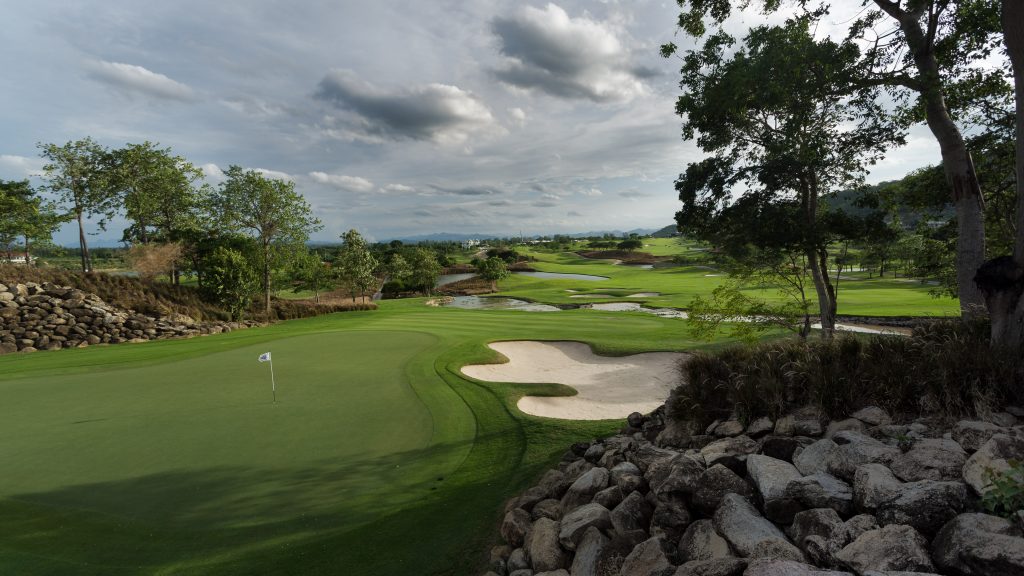
Some of these courses were in very fine condition, especially Black Mountain and Banyan, where the greens rolled perfectly. Banyan is beautifully set on a former pineapple plantation. It has mountains, rolling terrain and water, and the buildings are tucked away enough that the course keeps its natural character. The most dominant building is a temple on top of a cliff above the fairway, where a Buddhist monk has lived for the past 30 years.
Asked what the monk thought about a golf course being built right below his temple, the pro answers, “We don’t know. He has taken a vow of silence.”
Black Mountain is the highest-ranked course in Hua Hin; it’s where the European Tour stops when it’s in the neighborhood. The Thailand Classic, a tournament co-sanctioned by the Asian Tour and the European Tour, will be played at Black Mountain through 2017.
Several well-known players use Black Mountain as a winter base, including Johan Edfors, Alex Norén, Rikard Karlberg and Thongchai Jaidee.
The round at Palm Hills went just fine; there were several five-balls, but I ended up in a regular four-ball. The course is the closest to Hua Hin, but has perhaps been overtaken by some of the newer, more spectacular courses that have arrived since it opened in the early 1990s.
North of Bangkok, Kirimaya was an incredible experience: golf on a Jack Nicklaus course with demanding approach shots and big bunker complexes in the middle of the jungle. There’s a wonderful calm over the whole place, a mood that became even more magical as we listened to the tropical birds and watched lightning strike the distant Khao Yai mountains at dusk from the balcony of our villa.
How lovely to sit there taking life easy, with a Singha or a green coconut with a straw, depending on the mood. Life drifts slowly by, and we’re in no hurry. This is Thailand.
This article by Kaia Means was originally published in Norwegian on our sister site Golfjournalen.no. It has been translated by AI.